Key Takeaways:
- Play therapy uses play as the main way a child communicates. Talk therapy relies on words and abstract thinking.
- Most kids under about 9 or 10 do better with play therapy, even if they are very verbal at home.
- Play therapy is real therapy. It is not a playdate. The therapist is actively trained to notice and respond to what the child is communicating through play.
- The right fit depends on developmental stage more than exact age.
- Some kids move from play therapy into activity therapy, which bridges the gap between play and traditional talk therapy.
How Play Therapy and Talk Therapy Actually Differ
The Real Difference Is the Mode of Communication
Most parents have a general sense of what talk therapy looks like. They have seen it on television or heard about it from friends. Two people in a room, talking through problems, looking for insight.
Play therapy is less familiar, which makes sense. Fewer people have seen it modeled.
The main difference comes down to how the child communicates.
Talk therapy focuses mostly on what is processed verbally. The client puts feelings into words, and the therapist helps make sense of those words.
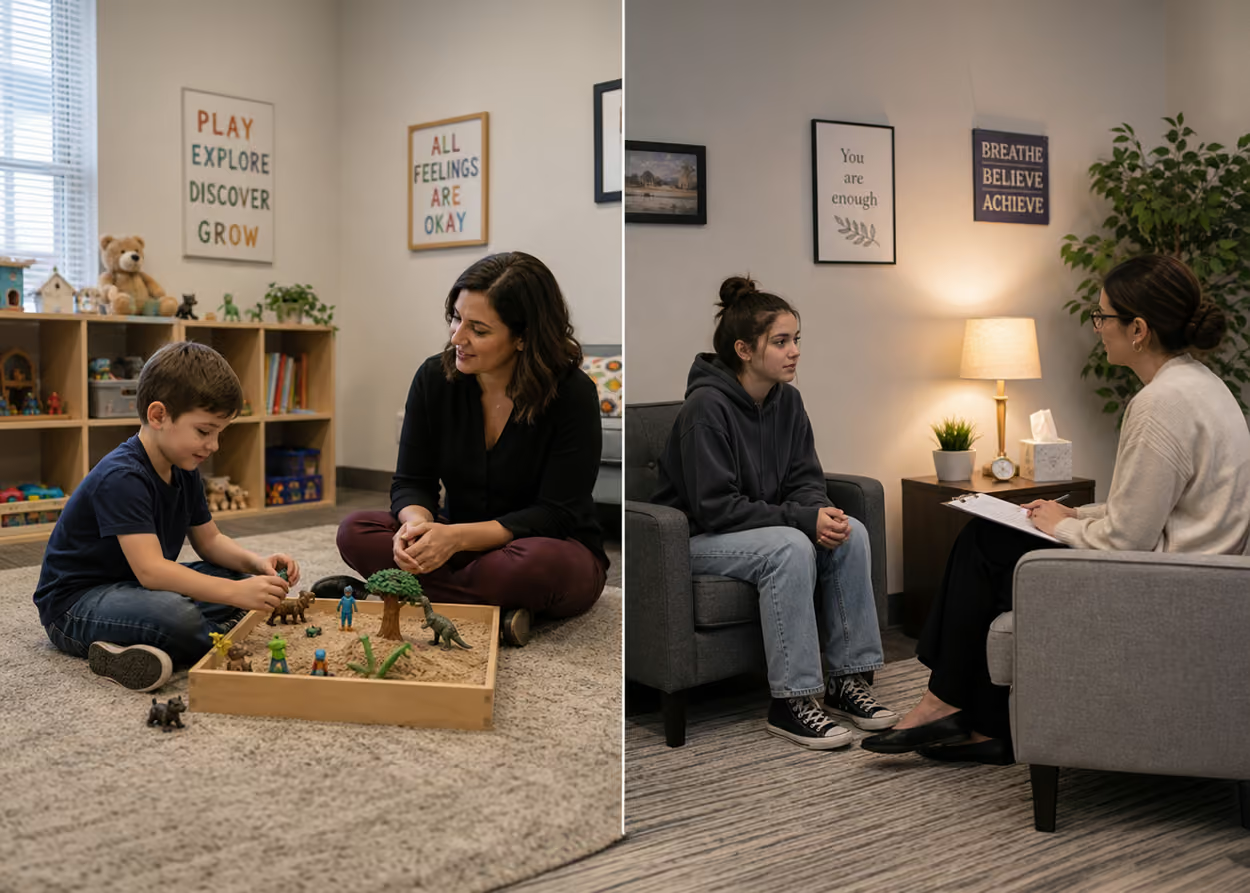
Play therapy focuses on what a child communicates through action. Through movement, role play, the toys they choose, the stories they act out, and the things they say while they play. A child in play therapy is not just keeping their hands busy while they talk. The play itself is the communication.
Gary Landreth, one of the foundational voices in child-centered play therapy, puts it this way:
"Children express themselves more fully through self-initiated, spontaneous play than they do verbally because they are more comfortable with play. For children to play out their experiences and feelings is the most natural dynamic and self-healing process they can engage in." (Landreth, 2023)
In other words, play is not a warm-up for the real therapy. Play is the real therapy.
Play Is a Child's First Language
Children are preverbal before they are verbal. Long before a child can say "I feel anxious" or "I am angry about what happened at school," that child is feeling those things in their body and expressing them through behavior.
Play therapy meets the child at their developmental level instead of asking the child to meet the therapist at an adult level.
Words are symbols, and symbols are abstractions. Most children are not developmentally able to engage fully in abstract reasoning until around age 11. So when a therapist says to a young child, "Tell me about it," the child is at an immediate disadvantage. They are being asked to translate a felt, lived experience into abstract language they may not yet have (Landreth, 2023).
Play is concrete. It lets the child show what they cannot yet say.
A highly anxious 4-year-old may not be able to explain what is happening inside their body. But in the playroom, that same child can show you. They may freeze at first, too overwhelmed to touch the toys. Over time, as the room feels safer, they may begin to play on their own, not yet ready to invite the therapist in. Later, they may ask the therapist to draw with them, or play dolls, or simply follow them around the room.
That progression is the work. The play is how the child regulates, explores, and eventually lets another person into their world.
Why a Very Verbal 7-Year-Old Still Benefits from Play Therapy
Parents sometimes say, "My child talks all the time. They can tell me exactly what they are thinking. Wouldn't talk therapy work?"
A very verbal child can certainly benefit from a therapist who listens well. But verbal expression at home is not the same as emotional processing in therapy.
Even a chatty 7-year-old is still developing the ability to connect feelings to words in a therapeutically useful way. Play therapy allows that child to express themselves both verbally and nonverbally. Both matter.
A child may be able to say "I was mad at school today." What they may not yet be able to say is "I felt small when my teacher corrected me in front of everyone, and it reminded me of something else that happened at home, and underneath the anger I was actually afraid."
Play creates a wider entry point. It lets the child bring more of themselves into the room than words alone would allow.
Frank (1982) suggested that play is the way children learn what no one can teach them. It is how they explore and orient themselves to the actual world of space and time, of things, animals, structures, and people. Through play, children learn to live in a world of meanings and values while also exploring and experimenting (as cited in Landreth, 2023).
When and How the Shift to Talk Therapy Happens
When Does a Child Shift Toward Talk Therapy?
The shift is not about hitting a magic age. It depends on the child.
I start moving toward more activity-based or expressive work around age 9 or 10, depending on the child. Some kids are ready sooner. Others need longer in the playroom.
One bridge I use often, especially with boys, is activity therapy. We might shoot a basketball while we talk. The activity gives the conversation somewhere to go, so the pressure to sit still and make eye contact drops away.
A question like "When did you get mad this week?" lands differently when a pre-teen is shooting from the three point line than when they are sitting across from an adult in a quiet room. The ball keeps moving. The body stays engaged. The words have somewhere to land.
Activity therapy is not a lesser form of therapy. It is a developmentally appropriate bridge between play and traditional talk. Research on play therapy with adolescents supports the use of activity-based approaches as a way to engage older kids who may have outgrown traditional play but are not yet comfortable with purely verbal therapy (Breen & Daigneault, 1998).
Does Being Direct Show Up Differently in Play Therapy?
I believe in being direct with people, even kids, when it is clinically appropriate. But the form that directness takes depends on the child's developmental stage.
In traditional child-centered play therapy, the child leads. I follow their play and respond to what they bring into the room. I do not turn the session into an interrogation.
In activity therapy or more expressive work with older kids, there is more room for direct conversation. That may include questions about the hard things. Questions like, "Do you like hanging out with your parents?" or "Do you feel exhausted by all the sports you are in?" or "Do you feel pressure to be perfect?"
Those conversations require a level of abstract thinking and trust that younger children have not yet developed. They become possible when the child is ready, not when I decide it is time.
The mode shifts. The commitment to honesty and care does not.
What Parents Often Wonder About Play Therapy
Why Parents Struggle to Trust Play Therapy
The hardest part for many parents is the feeling that nothing substantive is happening. Play therapy looks like playing, and parents wonder if they are paying for a playdate.
That concern is understandable. But the two are not the same.
A playdate is unstructured, peer-directed, and social. Play therapy is a trained therapeutic intervention. I am not just sitting in the room while a child plays. I am actively tracking themes, reflecting feelings, setting limits, encouraging autonomy, and watching for patterns the child may not have words for yet.
There is also something unique about the playroom itself. For many young children, it is one of the only spaces in their lives where they are not being told what to do.
At home they are told when to eat, when to sleep, when to put on shoes, and how to behave. At school they are told where to sit and when to speak. In the playroom, within safe limits, the child leads.
That sense of control is not a small thing. It builds self-esteem and gives the child a felt experience of being capable. That is part of the therapy.
Landreth (2023) describes child-centered play therapy not as a set of techniques but as a philosophy for living one's life in relationships with children. It is based on a deep belief in the child's capacity and resiliency to be constructively self-directing. Children are granted freedom in the play therapy relationship to be themselves in the process of playing out feelings and experiences.
What About Parents Who Want Their Child to "Just Talk"
I have not had a parent ask me directly, "When will my child actually start talking about their problems?" But I hear from other therapists that it is a common question.
The honest answer is that processing and healing take time. You cannot plant a seed and then ask it why it has not sprouted a flower yet.
A child in play therapy may not come home and say, "Today I processed my anxiety about school." Progress may look like a child who sleeps a little better, or has fewer meltdowns, or starts naming one feeling instead of acting it out.
Parents are a critical part of this process. I see a child for one hour a week. Parents are with that child for the rest of the week. What you notice at home, what you share with me, and how you respond to your child's behavior all shape the work.
I also want to be clear about something. Parenting is exhausting. No one expects you to become your child's therapist. In the playroom, your child has my full attention for one hour. That is not a realistic standard for home life.
You are doing your best. Let's work together to help your child flourish.
Ready to Learn More?
If you are trying to decide whether play therapy or talk therapy is the right fit for your child, I offer a free 15-minute consultation. We can talk through your child's developmental stage, what you are seeing at home, and what approach would best meet them where they are.
I see children ages 3 and up for play therapy in person at Connect to Thrive in Plano, TX. Older kids and teens can be seen in person or virtually anywhere in Texas.
Call or text: (972) 872-8510
Email Me: aaron@thriveplano.com
Book a free consultation
Disclaimer:The content provided in this article is for informational and educational purposes only and is not intended as mental health advice, diagnosis, or treatment. Reading this material or interacting with this site does not establish a professional counselor-client relationship. These resources are not a substitute for professional mental health evaluation or therapy. If you or someone you know is in crisis or needs mental health support, please consult a licensed healthcare professional or contact a emergency crisis resource such as the 988 Suicide & Crisis Lifeline by calling or texting 988.